Care in Queen Creek
Chiropractic and Physical Therapy, Working Together
Chiropractic care is where most patients start, and for good reason.
The spine is the central highway your nervous system runs through, and when a segment loses its normal motion, it doesn't just create local pain — it changes how you move, how you compensate, and eventually how the rest of your body has to adapt around it.
- 4.9 on Google · 147 reviews
- Queen Creek, Arizona
Understand the service
Restoring How Your Spine Moves — Not Just How It Feels.
- 01
How Chiropractic Care Works
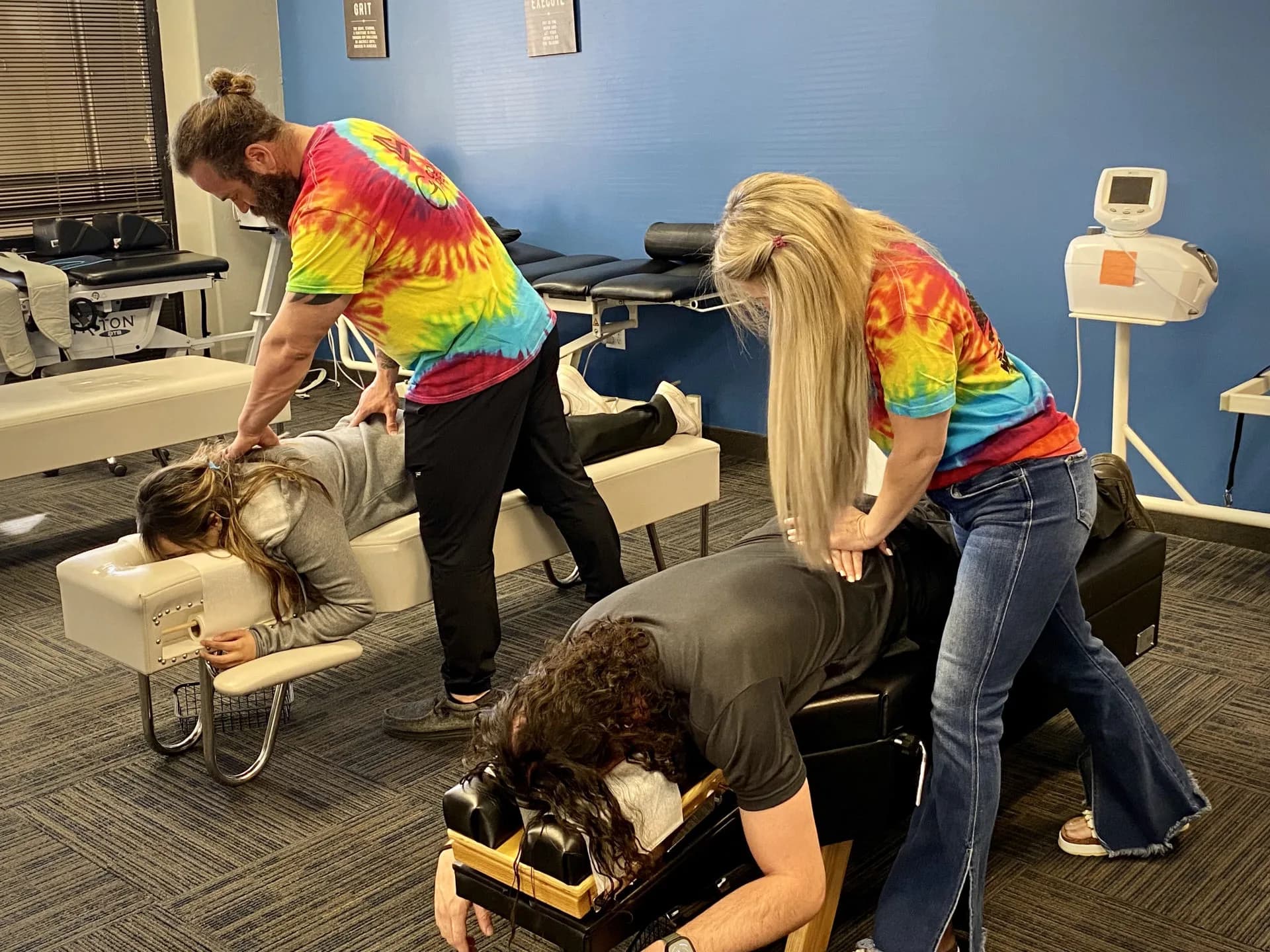
An adjustment restores motion to a joint that has become fixed or restricted. When a vertebral segment stops moving the way it should — from injury, posture, repetitive stress, or simple disuse — the joints above and below it start doing extra work to make up the difference. That compensation is often where the pain actually shows up, even though the restriction started somewhere else. Restoring proper motion takes the load off those compensating areas and lets the whole system move the way it's supposed to again.
But an adjustment by itself is a moment, not a program. The joint moving better today doesn't mean your body has learned to keep it that way — that requires practice, not just correction. That's why we don't treat chiropractic care as a stand-alone fix.
- 02
What Chiropractic Care Treats
Chiropractic care is effective across a wide range of spine and joint-related conditions, including:
- Back pain, neck pain, and general spinal stiffness
- Headaches, particularly those originating from the neck
- Sciatica and disc-related nerve symptoms
- Whiplash and other accident-related joint injuries
- Postural dysfunction and joint restriction throughout the spine and extremities
- 03
Physical Therapy: Where Relief Turns Into Capacity
Physical therapy is the part of your care that determines whether progress lasts. Adjustments, soft tissue work, and pain-relief modalities create a window — motion restored, tension released, inflammation calmed — but a body that regains a capability and never practices using it will lose it again. Physical therapy is how we make sure that doesn't happen.
Every program here is built on four connected pieces. Functional movement rehabilitation restores the patterns your body actually uses in daily life, sport, and work — not isolated exercises in a single plane. Neuromuscular re-education retrains the communication between your brain and the muscles that get inhibited after injury or surgery. Progressive load rehabilitation systematically challenges muscle, tendon, ligament, and bone so they adapt and strengthen rather than staying fragile. And for surgical cases, post-surgical rehabilitation aligns every phase of loading with your surgeon's specific protocol.
Healing gets tissue back to baseline, but baseline was never the goal. We're rebuilding capacity — the margin between what your life actually asks of your body and what it can handle without breaking down again.
- 04
What Physical Therapy Treats
Physical therapy applies across nearly every condition we see, including:
- Post-injury and post-surgical recovery of any joint or region
- Chronic pain driven by movement dysfunction and compensation
- Sports performance, return-to-play, and return-to-activity goals
- General deconditioning and loss of function following illness or inactivity
The surgeon repairs the hardware. We train what runs on top of it — the strength, coordination, and range your body needs to actually trust the repair again. That's the part most people never get, and it's the part that determines whether you stay better.
- 05
What to Expect
Your first visit includes a thorough assessment of spinal and joint motion, posture, and any specific complaints, so your adjustment is targeted rather than generic. Adjustments themselves are typically quick and, for most patients, produce an immediate sense of improved motion, though the underlying tissue and movement pattern changes build over a series of visits. We use diversified and instrument-assisted adjusting techniques, matched to what your body responds to best, along with joint mobilization for restrictions that aren't quite ready for a full adjustment.
Your physical therapy program starts with a full movement assessment establishing where you are today — strength, range of motion, movement quality, and specific deficits related to your condition. From there, sessions progress through phases: protecting and restoring motion, rebuilding strength and control, and finally returning to the full demands of your life, sport, or work. Each session is progressed based on where you are that day, and you'll leave with clear direction on what to work on between visits so progress continues outside the clinic.
- 06
How It Fits Into Your Plan
Every adjustment is paired with the soft tissue work, movement retraining, and progressive loading that teach your nervous system to hold the change, not just experience it for a day. Physical therapy is rarely used alone — it's the piece that locks in the gains made everywhere else in your plan.
- Combined with soft tissue therapy to address the muscle restriction surrounding the joint
- Paired with therapeutic exercise to retrain the movement patterns around the correction
- Integrated with decompression for cases involving disc-related symptoms
- Used as an ongoing maintenance tool for patients managing chronic conditions
- Coordinated directly with your surgeon's protocol for post-surgical cases
- The foundation for any return-to-sport or performance goal
Most people think of chiropractic care as something you keep doing forever because the relief never quite holds. In our experience, that's usually a sign the adjustment was never paired with anything that taught the body to hold the change. When we combine chiropractic care with the rest of your program, you don't just feel better between visits — you build the capacity to stay that way.
Ready to Talk About Your Next Step?
Request an appointment online, or call (480) 788-3424 to speak with the office.
FAQ
Frequently Asked Questions
Clear answers about visits, services, and what to expect from care at Complete Rehab QC.